
Ever feel like the world of technology is a constant race to the future? One minute we’re marveling at AI’s capabilities, the next it’s self-driving cars, and then… Quantum Computing. It sounds like something out of a sci-fi movie, but it’s quickly evolving from theoretical physics into a tangible reality that could reshape nearly every industry imaginable.
The Buzz Around Quantum: What’s the Big Deal?
Let’s face it, the term “quantum computing” gets thrown around a lot. But what does it actually mean, and why is everyone so hyped? The core idea is simple, yet mind-bending. Instead of the bits (0s and 1s) that traditional computers use,
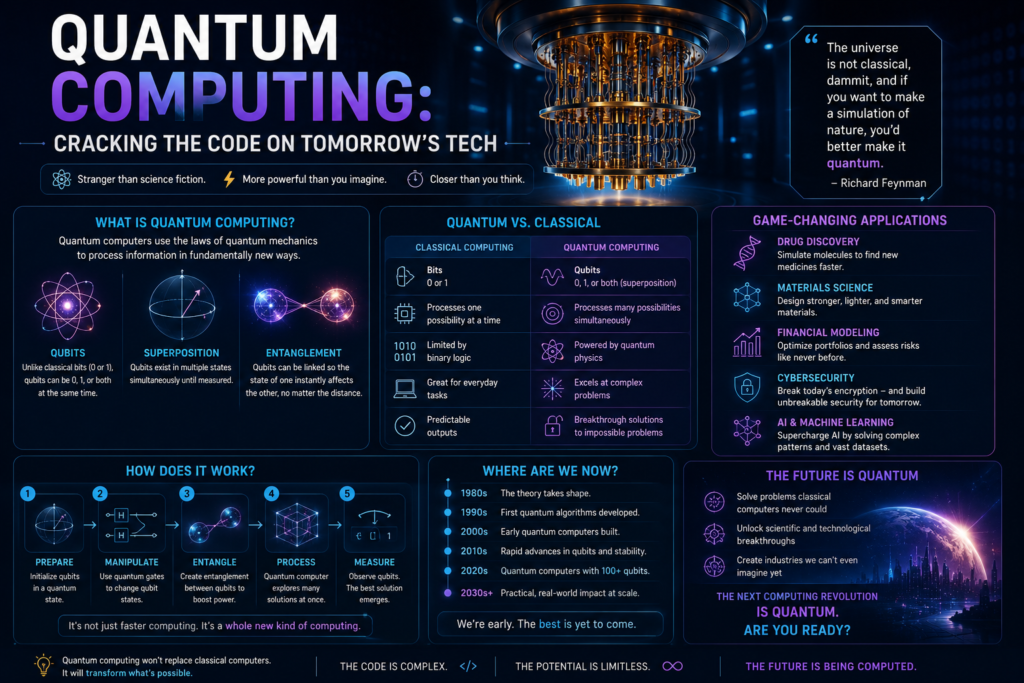
quantum computers utilize “qubits.” These qubits leverage the bizarre laws of quantum mechanics to exist in a state of superposition essentially, they can be 0, 1, or both at the same time. This seemingly small difference unlocks a massive increase in processing power. Think of it like this: Imagine a light switch. A regular computer’s bit is either “off” (0) or “on” (1). A qubit, however, is like a dimmer switch. It can be fully off, fully on, or anywhere in between.
This allows quantum computers to perform complex calculations exponentially faster than even the most powerful supercomputers we have today. This is not about making current computers “faster”; it’s about doing fundamentally different kinds of computations that are currently impossible.
From Lab to Laptop: The Evolution of Quantum Computing
Quantum computing isn’t a new concept. The theoretical groundwork was laid in the early 1980s by physicists like Richard Feynman and David Deutsch,
who recognized the limitations of classical computers in simulating quantum systems. For decades, it remained largely in the realm of theoretical physics and academic research.
Early quantum computers were fragile, expensive, and prone to errors. They existed only in highly controlled laboratory environments.
A major hurdle has been “decoherence,” where qubits lose their quantum properties due to interactions with their environment. The challenge has been to isolate and protect the delicate quantum states of the qubits.
However, over the past decade, there’s been an explosion of investment and innovation. Companies like IBM, Google, and Microsoft have poured billions into developing quantum hardware and software.
We’re seeing different approaches to building qubits, including superconducting circuits (IBM’s approach), trapped ions (used by IonQ), and photonic qubits (focused on by PsiQuantum). Each approach has its own strengths and weaknesses, and the “best” technology is still up for grabs.
The progress has been remarkable. While we’re still far from ubiquitous quantum computers on every desk, we’re seeing steady improvements in qubit stability, coherence times (how long qubits can maintain their quantum state), and the number of qubits in a single processor.
We’re entering the “Noisy Intermediate-Scale Quantum” (NISQ) era, where quantum computers have a limited number of qubits, but can still perform calculations beyond the reach of classical computers.
How Quantum Computers Work: Breaking Down the Magic
Understanding the basics of how quantum computers operate requires getting familiar with some key concepts:
- Qubits: The fundamental unit of quantum information, capable of existing in superposition (0, 1, or both).
- Superposition: The ability of a qubit to be in multiple states simultaneously, allowing for parallel processing.
- Entanglement: A bizarre phenomenon where two or more qubits become linked, and the state of one instantly influences the state of the others, regardless of distance.
- Quantum Algorithms: Special algorithms designed to take advantage of quantum phenomena like superposition and entanglement. Examples include Shor’s algorithm (for factoring large numbers) and Grover’s algorithm (for searching unsorted databases).
- Decoherence: The loss of quantum properties in qubits due to interaction with the environment. Preventing decoherence is a major challenge.
Quantum computers don’t just “go faster” at all tasks. Instead, they excel at specific types of problems that are intractable for classical computers. These include:
- Optimization Problems: Finding the best solution from a vast number of possibilities (e.g., supply chain optimization, financial modeling).
- Drug Discovery and Materials Science: Simulating the behavior of molecules and materials to design new drugs, catalysts, and materials with unprecedented properties.
- Cryptography: Breaking existing encryption algorithms (like RSA) and developing new, quantum-resistant encryption methods.
- Artificial Intelligence: Accelerating machine learning algorithms and enabling new AI capabilities.
Quantum computers are not meant to replace your laptop or smartphone. They are specialized tools designed for complex computations, and they will likely be accessed remotely, through the cloud, by specialized users.
Common Misconceptions About Quantum Computing
The hype surrounding quantum computing often leads to misunderstandings. Let’s debunk some common myths:
- Myth: Quantum computers will replace all classical computers.Reality: Quantum computers are specialized tools, not general-purpose machines. They will likely work alongside classical computers, with each handling the tasks it’s best suited for.
- Myth: Quantum computers can solve any problem.Reality: Quantum computers are designed for specific types of problems, such as optimization, simulation, and certain cryptographic tasks. They aren’t a magic bullet.
- Myth: Quantum computers are just around the corner.Reality: While significant progress has been made, quantum computing is still in its early stages. Practical, fault-tolerant quantum computers that can solve real-world problems at scale are still several years away. They are not a consumer product.
- Myth: Quantum computers will make all current encryption obsolete overnight.Reality: Quantum computers *could* break existing encryption, but it will take time. There’s an active effort to develop quantum-resistant encryption algorithms to secure our data in the quantum era.
Real-World Applications: Where Quantum Computing Will Make a Difference
The real impact of quantum computing will be visible when it is used to solve current problems. Here are some of the areas where quantum computing is expected to have a major impact:
- Drug Discovery: Quantum computers can simulate the behavior of molecules with unprecedented accuracy, accelerating the discovery of new drugs and therapies. This could lead to faster development of treatments for diseases like cancer and Alzheimer’s.
- Materials Science: Designing new materials with specific properties (e.g., superconductors, advanced batteries, more efficient solar cells) will be revolutionized by quantum simulations.
- Financial Modeling: Quantum computers can optimize complex financial models, such as portfolio optimization, risk analysis, and fraud detection.
- Logistics and Supply Chain: Optimizing logistics and supply chains, leading to more efficient delivery networks and reduced costs.
- Artificial Intelligence: Quantum computers can accelerate machine learning algorithms and potentially enable entirely new AI capabilities.
- Cryptography: Developing new quantum-resistant encryption methods to protect data from quantum attacks.
Quantum Computing in 2025–2026: The Current Landscape
In 2025–2026, the quantum computing landscape is evolving rapidly. We are in a period of intense competition, with companies and governments investing heavily in research and development. Some key trends include:
- Hardware Advancements: Steady progress in building more stable and powerful qubits, with increasing qubit counts and longer coherence times.
- Software Development: The emergence of quantum software platforms and programming languages to make quantum computing more accessible.
- Cloud-Based Access: Increased availability of quantum computers through cloud services, allowing researchers and businesses to experiment with quantum computing without needing to build their own hardware.
- Quantum-as-a-Service (QaaS): The rise of QaaS providers offering access to quantum computing resources and expertise.
- Quantum Education: Growing interest in quantum computing education and training programs to build a skilled workforce.
- Quantum Security: A focus on developing quantum-resistant encryption and security protocols to protect data from quantum attacks.
The market is still nascent, but analysts predict substantial growth in the coming years. Many businesses are starting to explore potential use cases and prepare for the quantum era.
The Future of Quantum: Innovation, Regulation, and Adoption
The future of quantum computing is full of both promise and uncertainty. Several factors will shape its evolution:
- Continued Hardware Innovation: Breakthroughs in qubit technology, leading to larger, more stable, and fault-tolerant quantum computers.
- Software Development: More user-friendly quantum programming languages, algorithms, and software tools to make quantum computing more accessible.
- Quantum Ecosystem: The development of a robust quantum ecosystem, including hardware vendors, software developers, service providers, and end-users.
- Quantum Education and Workforce Development: Training a skilled workforce to design, build, and use quantum computers.
- Regulation and Standards: Establishing standards and regulations for quantum computing, including cybersecurity, data privacy, and ethical considerations.
- Ethical Considerations: Addressing the ethical implications of quantum computing, such as the potential for misuse (e.g., breaking encryption) and the impact on society.
The timeline for widespread adoption is hard to predict. It will likely take years of continued innovation and investment. But when it arrives, it has the potential to transform numerous industries and reshape our world.
Quantum Computing FAQ
Here are some frequently asked questions about quantum computing:
- What is the difference between a classical computer and a quantum computer?Classical computers use bits (0s and 1s), while quantum computers use qubits. Qubits can be 0, 1, or both simultaneously (superposition), enabling quantum computers to perform complex calculations much faster for specific problems.
- How far away are we from a fully functional, fault-tolerant quantum computer?While significant progress has been made, we are still several years away from practical, fault-tolerant quantum computers that can solve real-world problems at scale. The timeline depends on continued breakthroughs in hardware and software.
- What are the biggest challenges in building quantum computers?The biggest challenges include building stable and controllable qubits, preventing decoherence (the loss of quantum properties), and developing quantum algorithms and software.
- What industries will be most impacted by quantum computing?Drug discovery, materials science, finance, logistics, artificial intelligence, and cybersecurity are among the industries expected to be most impacted by quantum computing.
- Can quantum computers break all encryption?Quantum computers *could* break some existing encryption algorithms, but not all. There is an active effort to develop quantum-resistant encryption methods to protect data.
- How can I learn more about quantum computing?There are many resources available, including online courses, books, and articles. Many universities and research institutions offer introductory courses and workshops on quantum computing. Some companies also provide tutorials and educational materials.
- Will quantum computers replace my computer?No, quantum computers are not meant to replace your laptop or smartphone. They are specialized tools designed for complex computations that classical computers struggle with. They will likely work alongside classical computers.
Quantum computing is on the cusp of revolutionizing several aspects of our lives. While many technical hurdles remain, the momentum is building.
It’s an area to watch closely, as it will likely impact the world in significant and unexpected ways. To stay informed about the latest advances, you can explore resources like Infosprout to keep up with developments in the tech landscape.
– IBM Quantum Computing: https://www.ibm.com/quantum
– Google Quantum AI: https://quantumai.google/
– MIT Lincoln Laboratory – Quantum Computing: https://www.ll.mit.edu/
– Nature – Quantum Computing Papers: https://www.nature.com/
– IEEE – Quantum Computing: https://www.ieee.org/
– ArXiv – Quantum Computing Research: https://arxiv.org/
– Princeton – Quantum Physics Explained: https://www.youtube.com/@princetonstuff