
Ever gazed at the night sky and felt a sense of wonder, a curiosity that whispers of the unknown? Perhaps you’ve pondered the existence of colossal entities that warp space and time itself, objects so dense that nothing, not even light, can escape their gravitational grasp. Today, we’re diving deep into the captivating realm of black holes, exploring their nature, their impact on our universe, and what the future holds in the ongoing quest to unravel their secrets.
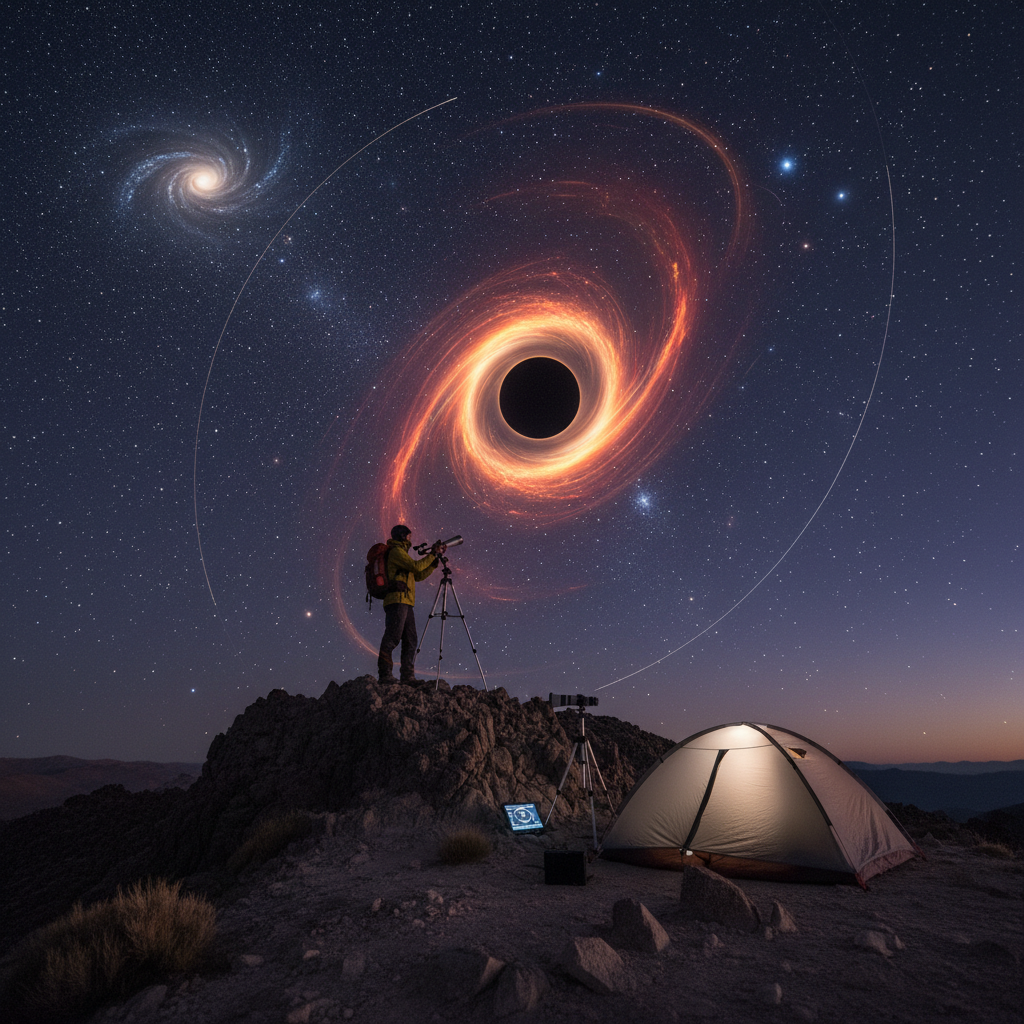
What Exactly Is a Black Hole?
Imagine a region of spacetime where gravity is so intense that nothing, not even light, can escape. This, in essence, is a black hole. It’s not a cosmic vacuum cleaner, sucking up everything in its path, as popular culture sometimes suggests. Instead, it’s a concentration of mass that creates an inescapable gravitational field. The boundary beyond which escape is impossible is called the event horizon. Think of it as a point of no return – once you cross it, you’re forever trapped within the black hole’s clutches.
To truly grasp this concept, you need to understand Einstein’s theory of general relativity. This theory revolutionized our understanding of gravity, presenting it not as a simple force but as a curvature of spacetime caused by mass and energy. The more massive an object, the greater the curvature it creates. Black holes represent the ultimate manifestation of this curvature, where spacetime is warped to an extreme degree.
How Do Black Holes Form?
The birth of a black hole is a dramatic event, typically associated with the death of a massive star. Stars, like our Sun, are powered by nuclear fusion in their cores, converting hydrogen into helium and releasing tremendous amounts of energy. However, once a star exhausts its nuclear fuel, it can no longer generate the outward pressure needed to counteract the inward force of gravity.
For stars at least 20 times the mass of the Sun, the core collapses under its own weight. This collapse can occur in several ways, often resulting in a supernova – a spectacular explosion that briefly outshines entire galaxies. The remnant core can then collapse further, crushing itself into an infinitely dense point known as a singularity, forming a black hole. This process, however, does not always lead to a black hole; in some instances, a neutron star may be formed instead.
Smaller black holes, known as stellar black holes, typically have masses ranging from about 5 to 100 times the mass of the Sun. They are scattered throughout galaxies, often lurking silently in the background.
Beyond Stellar Black Holes: Supermassive Black Holes
While stellar black holes are formed from the remnants of massive stars, supermassive black holes (SMBHs) are in a different league altogether. These behemoths reside at the centers of most galaxies, including our own Milky Way. Their masses can range from millions to billions of times the mass of the Sun. But how did these giants form? This is one of the most intriguing questions in astrophysics today. Several theories exist, including:
- Direct collapse: A massive cloud of gas collapses directly to form a supermassive black hole.
- Merging of smaller black holes: Stellar black holes collide and merge over billions of years.
- Accretion of matter: A black hole grows by swallowing surrounding gas and dust.
The exact mechanisms of SMBH formation remain an area of active research. But, their influence is undeniable. They shape the evolution of galaxies, influencing star formation and the overall structure of galactic environments.
Observing the Unseeable: How Do We Study Black Holes?
Given that black holes don’t emit light, how do scientists study them? The answer lies in their gravitational effects. Black holes interact with their surroundings, and these interactions provide clues about their presence and properties. Here’s how we “see” the unseen:
- Gravitational lensing: The extreme gravity of a black hole can warp the path of light from distant objects, causing them to appear distorted or magnified.
- Accretion disks: As gas and dust fall into a black hole, they form a swirling disk called an accretion disk. The friction within this disk heats the matter to incredibly high temperatures, causing it to emit X-rays and other forms of radiation that can be detected.
- Stellar orbits: By observing the motion of stars near the center of a galaxy, astronomers can infer the presence of a supermassive black hole and calculate its mass.
- Gravitational waves: When two black holes merge, they send ripples through spacetime called gravitational waves. These waves were first directly detected in 2015, opening a new window into the study of black holes.
The Event Horizon Telescope (EHT) is a global network of radio telescopes working in concert. It made history by capturing the first-ever image of a black hole, specifically the supermassive black hole at the center of the galaxy M87, confirming decades of theoretical predictions. This image provided definitive visual evidence of a black hole and its surrounding environment, a monumental achievement in astrophysics.
Lesser-Known Facts about Black Holes
The realm of black holes is filled with fascinating and sometimes counterintuitive concepts. Here are some facts that often surprise people:
- Spaghettification: Objects approaching a black hole are stretched and squeezed, a phenomenon called spaghettification. This is due to the extreme difference in gravitational force experienced by different parts of the object.
- Hawking Radiation: According to Stephen Hawking, black holes are not entirely black. They emit a faint radiation, known as Hawking radiation, due to quantum effects near the event horizon. This radiation causes black holes to slowly evaporate over extremely long timescales.
- Time Dilation: Time slows down near a black hole. An observer watching an object fall into a black hole would see it slow down and appear to freeze at the event horizon. From the perspective of the infalling object, time continues normally.
- Information Paradox: One of the most significant theoretical challenges surrounding black holes is the information paradox. When something falls into a black hole, its information seems to disappear. However, quantum mechanics suggests that information cannot be destroyed. Resolving this paradox is a major area of research.
The Impact of Black Holes: Cosmic Architects and Galaxy Regulators
Black holes are not just bizarre objects of scientific curiosity. They play a crucial role in shaping the universe. Their gravitational influence affects the structure of galaxies, the distribution of matter, and the evolution of cosmic structures. The presence of a supermassive black hole at the center of a galaxy can trigger star formation or, conversely, suppress it, depending on the dynamics of the environment.
The study of black holes provides us with an opportunity to test our understanding of fundamental physics, including general relativity and quantum mechanics. The ongoing research into black holes is crucial for our understanding of the universe, and it drives the development of new technologies and discoveries.
Modern Relevance: Black Holes in the 21st Century
The study of black holes is not confined to the realm of theoretical physics. It has real-world applications and implications.
- Advancements in Technology: The research on black holes, particularly related to gravitational waves, has spurred the development of advanced detectors and data analysis techniques that have applications in various fields, including medical imaging and materials science.
- Space Exploration: Understanding the behavior of matter near black holes can provide insights into the extreme conditions found in other parts of the universe. This can influence the design of future spacecraft and exploration strategies.
- Educational Outreach: The study of black holes and the mysteries surrounding them capture the imagination of the public, which promotes STEM (Science, Technology, Engineering, and Mathematics) education, research, and awareness.
Furthermore, the ongoing development of advanced telescopes, such as the James Webb Space Telescope, continues to provide unprecedented views of the universe, including the regions surrounding black holes.
Future Outlook: Exploring the Abyss
The future of black hole research is bright, full of promise, and challenges. Scientists are working on a variety of fronts:
- Continued Gravitational Wave Astronomy: The detection of gravitational waves from black hole mergers and other cosmic events will provide new insights into the nature of these objects and the universe itself.
- Multi-Messenger Astronomy: Combining data from gravitational waves, electromagnetic radiation, and neutrinos will offer a more comprehensive view of black hole systems.
- Theoretical Advancements: Physicists are working to reconcile general relativity with quantum mechanics, which could resolve the information paradox and deepen our understanding of black holes.
- Exploration of Extreme Environments: By studying the environment surrounding black holes, researchers hope to glean new information on the behavior of matter under extreme conditions.
The potential for discovery in the field of black holes is vast. Continued research will not only expand our understanding of the universe but also push the boundaries of human knowledge and technological capabilities. This research could reshape our understanding of the universe, opening new frontiers for exploration and discovery. The quest to unveil the mysteries of black holes continues, promising a future filled with wonder and profound insights.
FAQ Section
Here are some frequently asked questions about black holes:
-
What would happen if you fell into a black hole?
You would experience spaghettification – your body would be stretched and squeezed by the extreme gravitational forces. As you approached the event horizon, time would slow down dramatically relative to an outside observer. Eventually, you would cross the event horizon, and your fate would be sealed, with the singularity being the endpoint.
-
Can black holes move?
Yes, black holes can move. They can be pushed around by the gravitational forces of other objects or can move through space due to the influence of gravitational waves.
-
Do black holes have a “bottom”?
Black holes are not like containers with a bottom. Inside a black hole, space and time are distorted in such a way that the singularity at the center is a point of infinite density, not a boundary. There’s no “bottom” to reach, and all matter and energy that crosses the event horizon is pulled towards this central singularity.
-
Are all black holes the same size?
No, black holes come in various sizes. Stellar black holes are typically a few to hundreds of times the mass of our Sun. Supermassive black holes, found at the centers of galaxies, can be millions or even billions of times more massive than the Sun.
-
Can black holes collide?
Yes, black holes can collide and merge, which is one way they can grow in size. When two black holes collide, they produce gravitational waves, which can be detected by observatories on Earth. These events are some of the most powerful and energetic occurrences in the universe.
-
Are black holes dangerous to Earth?
No, black holes are not a threat to Earth. Even if a black hole were to come close to our solar system, its gravitational effects would be minimal unless it passed very close to the Earth. Black holes are not cosmic vacuum cleaners, and they do not “suck” everything in.
-
What is the difference between a black hole and a wormhole?
While often conflated in science fiction, black holes and wormholes are distinct concepts. A black hole is a region of spacetime with such strong gravity that nothing can escape. A wormhole, on the other hand, is a theoretical tunnel through spacetime, connecting two different points in the universe or even different universes. Wormholes are predicted by Einstein’s theory of general relativity, but they have never been observed, and their existence remains speculative.