
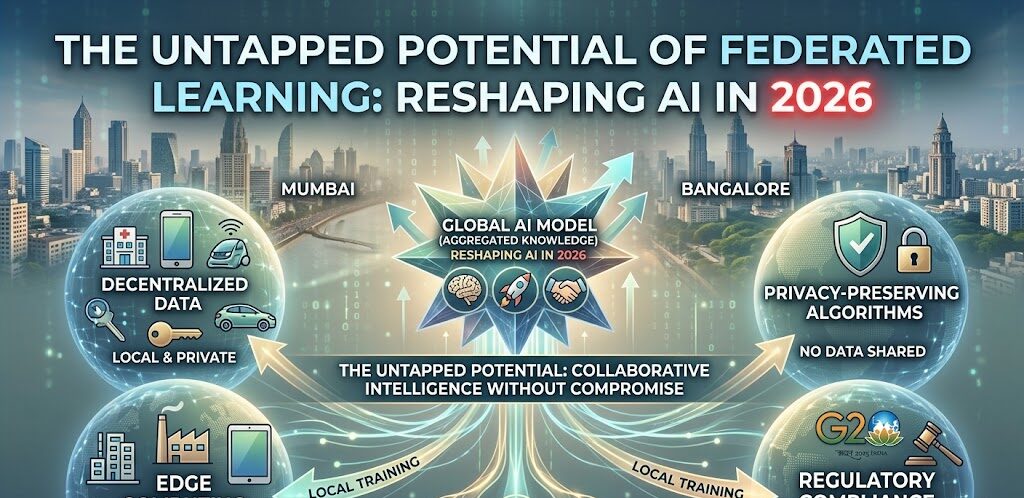
Ever wonder how your phone can predict the next word you’re about to type, or how medical research is advancing at breakneck speed, even with strict patient data privacy? The answer lies in a fascinating area of Artificial Intelligence called Federated Learning. It’s not just a buzzword; it’s a paradigm shift in how we approach AI, especially in an era where data privacy is paramount. In 2026, its impact is becoming increasingly visible.
The Data Dilemma: Why Traditional AI is Showing Cracks
Traditional AI models are built on a simple premise: collect vast amounts of data, centralize it, train the model, and deploy it. This works, but it brings several problems. Think of it like this: gathering all the world’s knowledge into one giant library. While efficient, it raises serious concerns about data ownership, security breaches, and ethical implications. Plus, it can be incredibly slow and costly to move and store massive datasets in one place.
The core problem with centralized AI is this: Data is the new oil. Whoever controls the data, controls the power. But unlike oil, data is often sensitive and personal. Data breaches are a constant threat, and regulations like GDPR and CCPA are making it increasingly difficult to collect and use data in the old ways. This creates a data dilemma – we want to leverage the power of AI, but we also want to protect our privacy and ensure ethical data handling.
Enter Federated Learning: AI That Learns Together, Without Being Together
Federated Learning offers a brilliant solution. Imagine a classroom where each student learns individually, but they all contribute to a shared understanding. In Federated Learning, the AI model is distributed across multiple devices or servers. Each device, or ‘client’, trains a local model on its own data. Then, instead of sharing the raw data, the clients share their model updates with a central server.
The central server aggregates these updates, creating an improved global model. This global model is then sent back to the clients, and the process repeats. This iterative process allows the model to learn from a massive pool of data without ever having to collect that data in one central location. It’s like a collective brain that gets smarter over time, without compromising the privacy of the individual brains contributing to it.
How Federated Learning Works: A Simple Breakdown
Let’s break down the process step-by-step:
- Initialization: A global AI model is created and distributed to various client devices (smartphones, hospitals, etc.).
- Local Training: Each client trains the model using its own local data. Think of it as each device doing its own homework.
- Update Sharing: Instead of sending raw data, the clients send their model updates (the ‘homework answers’) to a central server.
- Aggregation: The central server aggregates these updates, creating an improved global model. This is like the teacher collecting the homework and providing feedback.
- Iteration: The updated global model is sent back to the clients, and the process repeats. The model continuously improves with each iteration.
The key innovation here is the exchange of model updates, not the raw data. This is what protects data privacy and enables secure, collaborative learning.
Debunking Common Misunderstandings About Federated Learning
Federated Learning is often misunderstood. Here’s a breakdown of common myths and the realities:
- Myth: Federated Learning is only for giant tech companies. While companies like Google and Apple were early adopters, Federated Learning is accessible to all. Open-source frameworks and cloud platforms are making it easier for businesses of all sizes to implement it.
- Myth: Federated Learning is slow. While the initial training can take time, the efficiency gains in the long run often outweigh the initial investment. Improved infrastructure and optimization techniques are also making the process faster.
- Myth: Federated Learning eliminates the need for data. It doesn’t eliminate the need for data entirely, but it changes the game. It allows AI models to be trained on decentralized data sources, which are often rich with diverse datasets that would be otherwise inaccessible due to privacy or security restrictions.
- Myth: Federated Learning is a magic bullet. It’s not a cure-all. It requires careful planning, robust infrastructure, and a strong understanding of AI principles. It is, however, a powerful tool when applied correctly.
Real-World Applications: Where Federated Learning is Making a Difference
The real impact of Federated Learning is becoming visible in various sectors. Here are some examples:
Healthcare: Revolutionizing Medical Research and Patient Care
Federated Learning is transforming healthcare. Imagine hospitals and research institutions collaborating to build a more accurate diagnostic model for cancer detection, without sharing sensitive patient data. This is exactly what’s happening. Federated Learning allows medical professionals to:
- Improve Diagnostic Accuracy: Train AI models to detect diseases early and more accurately, based on a broad range of patient data from various hospitals.
- Accelerate Drug Discovery: Analyze clinical trial data across different research centers while respecting patient privacy.
- Personalized Medicine: Develop AI models that tailor treatment plans to individual patients, based on their unique medical history and genetic information, all without compromising their privacy.
Finance: Enhancing Security and Fraud Detection
In finance, data security is paramount. Federated Learning provides a secure way to:
- Detect Fraud: Analyze transaction data across multiple banks to identify fraudulent activities in real-time.
- Improve Credit Scoring: Create more accurate credit scoring models by leveraging data from different financial institutions.
- Enhance Cybersecurity: Develop AI models to detect and prevent cyberattacks by analyzing threat data in a distributed manner.
Retail: Personalizing the Shopping Experience
Retailers are using Federated Learning to provide more personalized shopping experiences, while respecting customer privacy. This enables them to:
- Improve Product Recommendations: Analyze customer behavior across different stores to provide more accurate product recommendations.
- Optimize Marketing Campaigns: Tailor marketing messages to individual customers based on their purchase history and preferences, without compromising their personal data.
- Enhance Inventory Management: Predict demand and optimize inventory levels by analyzing sales data from various locations.
Smartphones and Mobile Devices
You’re already using Federated Learning. The predictive text on your smartphone, and the improved voice recognition are powered by Federated Learning, constantly learning from your behavior without needing to access your private information.
The Benefits: Why Federated Learning is a Game Changer
Federated Learning offers many advantages over traditional AI approaches:
- Enhanced Privacy: Data never leaves the device or the local environment, protecting sensitive information.
- Improved Security: Reduces the risk of data breaches and cyberattacks.
- Faster Training: By leveraging the computing power of multiple devices, Federated Learning can often train models faster than centralized approaches.
- Reduced Costs: Eliminates the need for expensive data storage and transfer infrastructure.
- Increased Data Availability: Opens up access to a wider range of data sources that are otherwise inaccessible due to privacy restrictions.
Challenges and Limitations: Not a Perfect Solution
While Federated Learning offers many benefits, it’s not without its challenges:
- Communication Bottlenecks: Coordinating updates between numerous devices can be complex and slow, particularly with limited bandwidth.
- Data Heterogeneity: Data on different devices may vary significantly in quality, format, or distribution, which can affect the performance of the model.
- Model Aggregation Challenges: The process of aggregating updates from diverse devices can be complex, and may require advanced algorithms.
- Security Vulnerabilities: Though designed with security in mind, Federated Learning is still vulnerable to adversarial attacks, where malicious actors try to compromise the model by injecting bad data.
The Future of Federated Learning: Trends and Predictions for 2026 and Beyond
In 2026, Federated Learning is no longer a niche technology. It is rapidly expanding and evolving. Here are some key trends to watch:
- Federated Learning on the Edge: With the rise of edge computing, Federated Learning is moving closer to the data source. This means more processing power at the edge, reducing latency and improving efficiency.
- Increased Automation: Automated tools and platforms are making Federated Learning easier to implement and manage, enabling faster adoption across various industries.
- Integration with Blockchain: Blockchain technology can be used to improve the security and transparency of Federated Learning, creating a more robust system.
- Regulations and Standardization: As Federated Learning becomes more widespread, expect to see more regulations and standardization to ensure ethical data handling and privacy protection.
- Cross-Silo and Cross-Device: While initial applications were in the cross-device scenario (training on smartphones), the industry is seeing more adoption of cross-silo learning, where organizations train models together.
Ethical Considerations: Navigating the Responsible Use of Federated Learning
With great power comes great responsibility. Federated Learning raises critical ethical questions:
- Data Bias: If the data used to train the model is biased, the resulting model will also be biased. It is crucial to address and mitigate these biases during the data collection and model training process.
- Data Poisoning: Malicious actors can try to corrupt the training process by injecting false data. Robust security measures and validation techniques are essential to prevent this.
- Transparency and Explainability: It is important to understand how Federated Learning models make decisions. Explainable AI (XAI) techniques are critical to ensure transparency and build trust.
- Data Ownership and Control: It is essential to define clear guidelines on data ownership, control, and usage, and who benefits from the insights gained through Federated Learning.
Conclusion: The Path to a Smarter, More Private Future
Federated Learning is more than just a technological advancement; it’s a fundamental shift in how we approach AI. It empowers us to leverage the power of data while protecting privacy, fostering collaboration, and driving innovation across various industries. In 2026, we are witnessing the start of this transformation.
By understanding the concepts, debunking the myths, and recognizing the ethical implications, you can be part of this revolution. Explore the potential of Federated Learning in your business, career, or daily life. The future is here, and it’s being built, one secure and private data point at a time.
As you navigate the world of emerging technologies, the ability to adapt and learn is critical. Consider the importance of a “good enough” career as you build your tech skillset .
FAQ: Your Top Questions About Federated Learning Answered
Here are some of the most common questions people have about Federated Learning:
- What is Federated Learning in simple terms?Federated Learning is a way to train AI models on data that’s spread across many devices (like your phone or a hospital’s servers) without moving that data to a central location. Instead, each device trains the model locally, and then shares updates with a central server, which combines these updates to improve the model.
- How does Federated Learning protect privacy?Federated Learning protects privacy by sharing only model updates, not the raw data itself. This means that your personal information never leaves your device or the local environment.
- What are the main benefits of Federated Learning?The main benefits are enhanced privacy, improved security, faster training, reduced costs, and increased access to data that would otherwise be unavailable.
- Where is Federated Learning used today?It is used in healthcare, finance, retail, and on smartphones. Your phone’s predictive text and voice recognition are examples of Federated Learning in action.
- What are the challenges of Federated Learning?Challenges include communication bottlenecks, data heterogeneity, model aggregation difficulties, and potential security vulnerabilities, such as data poisoning.
- How does Federated Learning differ from traditional AI?Traditional AI trains models on centralized data, while Federated Learning trains models on decentralized data. Federated Learning prioritizes privacy and security, while traditional AI often prioritizes speed and efficiency, sometimes at the expense of privacy.
- Is Federated Learning the same as differential privacy?No, but they often work together. Differential privacy is a technique used to add noise to the data, protecting the privacy of individual data points. Federated Learning is the broader framework that enables training AI models on decentralized data. Differential privacy is one tool that can be used within Federated Learning to enhance privacy.
- What is the future of Federated Learning?The future of Federated Learning includes increased automation, more edge computing applications, integration with blockchain technology, and the development of stricter regulations and standardization.
– Google AI Blog: https://ai.googleblog.com/
– TensorFlow Federated: https://www.tensorflow.org/federated
– IEEE – Machine Learning Papers: https://ieeexplore.ieee.org/
– ArXiv – Machine Learning: https://arxiv.org/
– Medium – AI & ML: https://medium.com/
– Towards Data Science: https://towardsdatascience.com/
– Research Papers Archive: https://scholar.google.com/