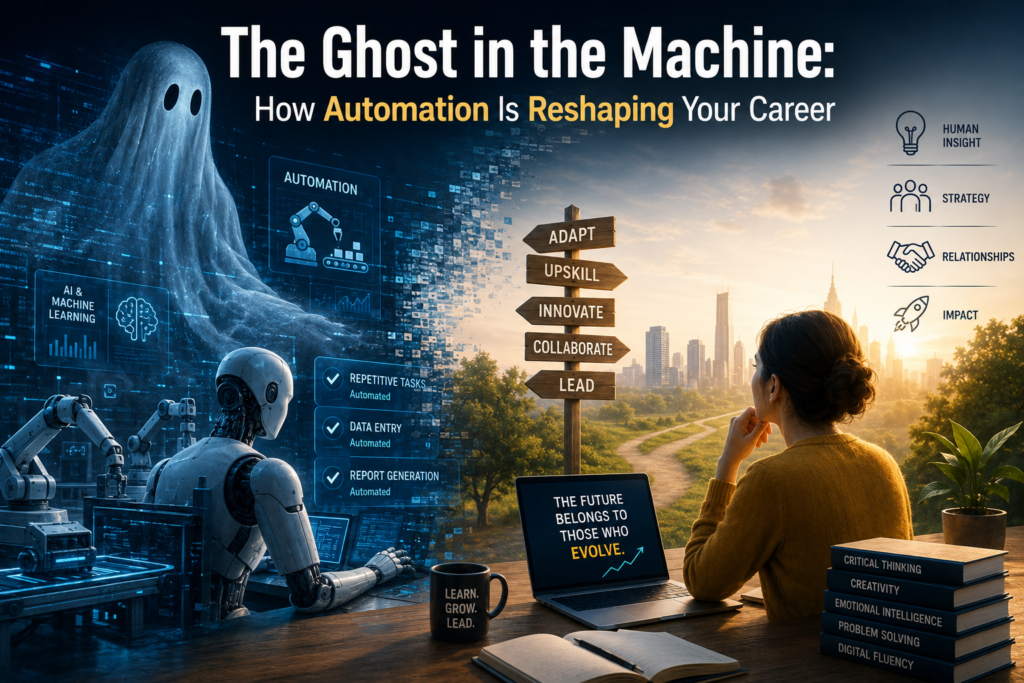
Remember those late nights, fueled by instant coffee and a burning desire to “make it”? The dreams of corner offices, six-figure salaries, and a life where Monday mornings didn’t feel like a death sentence? We’ve all been there. But here’s the cold, hard truth: the career landscape you envisioned is changing. And it’s changing fast. The “ghost in the machine” isn’t a supernatural entity, but rather automation and Artificial Intelligence (AI). They’re no longer futuristic concepts; they’re here, quietly reshaping industries and, by extension, your career prospects. This isn’t about robots taking over the world, but about the subtle, yet powerful, ways technology is altering what jobs exist, what skills are valued, and how you need to adapt to stay relevant.
The Automation Avalanche: Not Just Blue-Collar Anymore
For a long time, the fear of automation was primarily focused on factory workers and manual labor. The narrative was simple: machines replace humans, jobs disappear. While that’s certainly true in some sectors, the real story is far more complex and, frankly, a lot scarier for white-collar workers. AI and automation are creeping into areas we once considered safe: data analysis, customer service, even parts of finance and law.
Think about it. Accountants are losing ground to AI-powered software that can crunch numbers and generate reports faster and more accurately than any human. Paralegals are seeing their research tasks automated, freeing up lawyers for more strategic work (which, of course, means fewer paralegal jobs overall). Customer service reps are battling chatbots that are increasingly capable of handling basic inquiries. These aren’t just isolated incidents; it’s a trend, and it’s accelerating.
This is where most people feel lost and confused. They see the headlines, the warnings about “robots taking our jobs,” but they don’t know what to *do* about it. They feel trapped, like they’re watching a tidal wave approach with no escape route.
The Skills That Won’t Be Automated (Yet)
The good news? Not all skills are created equal. Some skills are surprisingly resistant to automation. These are the skills that require human qualities like creativity, critical thinking, emotional intelligence, and complex problem-solving. This is where your focus needs to be.
So, what skills should you be investing in? Here’s a breakdown:
- Critical Thinking & Problem-Solving: Machines can process data, but they can’t always make sense of it. They struggle with ambiguity, with nuance, with the “what ifs.” The ability to analyze complex situations, identify patterns, and develop creative solutions will be invaluable.
- Creativity & Innovation: AI can generate text, art, and music, but it can’t truly *create* in the way humans do. The ability to generate new ideas, think outside the box, and develop innovative solutions will be highly prized. This includes design, content creation, and strategic thinking.
- Emotional Intelligence & Communication: Machines lack empathy. They can’t understand human emotions or build genuine relationships. The ability to communicate effectively, build rapport, and navigate complex interpersonal dynamics will be crucial, particularly in leadership roles and client-facing positions.
- Adaptability & Lifelong Learning: The only constant is change. You need to embrace a mindset of continuous learning, be willing to acquire new skills, and adapt to evolving technologies and workplace practices. This includes being tech-savvy and comfortable with new software, platforms, and AI tools.
- Specialized Technical Skills (with a Human Touch): While basic coding and data entry can be automated, jobs that require advanced technical expertise, combined with human interaction and understanding, are safer. This includes roles like data scientists who interpret and present data to clients, or software engineers who lead teams.
The future isn’t about being replaced by a machine, it’s about partnering with one. You’ll need to learn how to use AI tools, understand their limitations, and leverage them to augment your own capabilities.
The Reality Check: Busting Career Myths
What nobody explains early in your career is how deeply the hiring process is changing, and how many of the “tried and true” pieces of advice are now flat-out wrong.
Let’s address some common career myths that are now obsolete:
- Myth: A degree guarantees success.
Reality: A degree is often a starting point, not a destination. It provides a foundation, but it’s the skills you develop and how you apply them that truly matter. Moreover, the cost of a degree is a huge factor in today’s market. - Myth: Loyalty ensures promotion.
Reality: Loyalty is appreciated, but it’s not a guarantee of advancement. Performance, skills, and networking are what drive promotions. The days of simply putting in your time and climbing the ladder are largely over. - Myth: Hard work alone is enough.
Reality: Hard work is necessary, but not sufficient. You also need to be strategic about your career. This means focusing on in-demand skills, building a network, and continuously seeking opportunities for growth. - Myth: Following your passion will lead to a successful career.
Reality: Passion is great, but it’s not a business plan. You need to consider market demand, financial stability, and the skills required. Sometimes, a “good enough” job that pays the bills allows you to pursue your passions outside of work. - Myth: Experience automatically trumps all.
Reality: Experience is valuable, but relevant experience is what matters. Simply having a long job history doesn’t make you more valuable if you haven’t developed in-demand skills or adapted to change.
At some point, reality hits: The “rules” have changed, and you need to adapt.
The Long-Term Impact: Income, Stability, and Lifestyle
The shifts in the job market will have a profound impact on your long-term income, stability, and lifestyle. Those who adapt to the new realities of automation and AI will be in a much stronger position. Those who don’t risk falling behind.
Consider the following:
- Income Potential: Those with in-demand skills and the ability to leverage AI tools will command higher salaries. The gap between those who adapt and those who don’t will widen. This means specialized expertise in AI, data science, and other technical fields are crucial to long-term income growth.
- Job Security: While no job is truly recession-proof, those with adaptable skills and a growth mindset will have greater job security. They will be more resilient to economic downturns and technological disruptions.
- Work-Life Balance: The rise of remote work and flexible schedules, accelerated by AI and automation, offers new possibilities for work-life balance. However, this also means the lines between work and personal life can blur. The key is to set boundaries and prioritize well-being.
- Lifestyle Choices: Your career choices directly impact your lifestyle. Consider where you live, your travel opportunities, and your ability to pursue personal interests. The right career path can unlock opportunities for fulfillment and a balanced life.
Actionable Steps: What You Can Do Now
So, what can you *do* to navigate this new world? Here’s a practical roadmap:
- Assess Your Skills: Conduct a thorough self-assessment. What skills do you have? What are your weaknesses? Be honest with yourself. Identify your skill gaps, particularly in areas related to critical thinking, creativity, and adaptability.
- Research In-Demand Skills: Research the job market. Which skills are in high demand? Which industries are growing? What are the key skills that employers are looking for? Focus on these, as they offer the greatest long-term security.
- Embrace Lifelong Learning: Commit to continuous learning. Take online courses, attend workshops, read industry publications, and stay up-to-date on the latest trends. Learning never ends. This is not just about gaining new skills; it’s about developing the mindset of a lifelong learner.
- Network Strategically: Build a strong professional network. Connect with people in your field, attend industry events, and leverage social media platforms like LinkedIn. Networking opens doors to new opportunities and provides valuable insights.
- Consider a Career Shift (or Supplement): If your current career is at high risk of automation, consider a career shift. This might involve upskilling, reskilling, or changing industries. In some cases, developing a side hustle or entrepreneurial venture can provide additional income and future-proof your career.
- Develop a “Future-Proof” Mindset: Embrace change, be adaptable, and be willing to take risks. A growth mindset is essential for navigating the evolving job market. This also means being comfortable with failure, viewing setbacks as learning opportunities, and continually seeking new challenges.
- Seek Mentorship: Find a mentor who can guide you. Someone with experience in your field can provide valuable advice, share insights, and help you navigate the complexities of career growth. The right mentor can make all the difference.
This path isn’t easy, but it’s essential. The ghost in the machine isn’t an enemy; it’s a force you must understand and, ultimately, partner with to thrive in the years ahead.
FAQ: Your Burning Questions Answered
Here are some frequently asked questions to clarify the concepts discussed:
- How can I identify skills that are “safe” from automation?
Focus on skills that require human interaction, creativity, critical thinking, and emotional intelligence. Research job descriptions and look for keywords that emphasize these qualities. - What are some good online resources for learning new skills?
Platforms like Coursera, edX, Udemy, and LinkedIn Learning offer a wide range of courses and certifications. Consider industry-specific training programs to sharpen your skills. - Is it too late to change careers?
No! It’s never too late. The job market is constantly evolving, and there are always opportunities for those willing to adapt and learn new skills. You may even find success through a Infosprout guide on career pivots! - How do I build a strong professional network?
Attend industry events, connect with people on LinkedIn, join professional organizations, and reach out to people for informational interviews. - What if I’m not sure what career path is right for me?
Experiment! Take online assessments, explore different industries, and shadow professionals in different roles. Don’t be afraid to try new things and embrace the learning process. - How do I stay motivated during a career transition?
Set realistic goals, celebrate small victories, and seek support from friends, family, or a career coach. Remember your “why” and focus on the long-term rewards. - Should I be worried about AI taking my job?
It’s smart to be informed. Focus on skills that complement AI, like creativity, critical thinking, and emotional intelligence, and be proactive in acquiring them.
– World Economic Forum – Future of Jobs: https://www.weforum.org/
– McKinsey – Automation & Employment: https://www.mckinsey.com/
– LinkedIn Learning Insights: https://learning.linkedin.com/
– Coursera Learning Trends: https://blog.coursera.org/
– Harvard Business Review: https://hbr.org/
– Deloitte Technology Trends: https://www2.deloitte.com/
– Forbes – Career Development: https://www.forbes.com/