
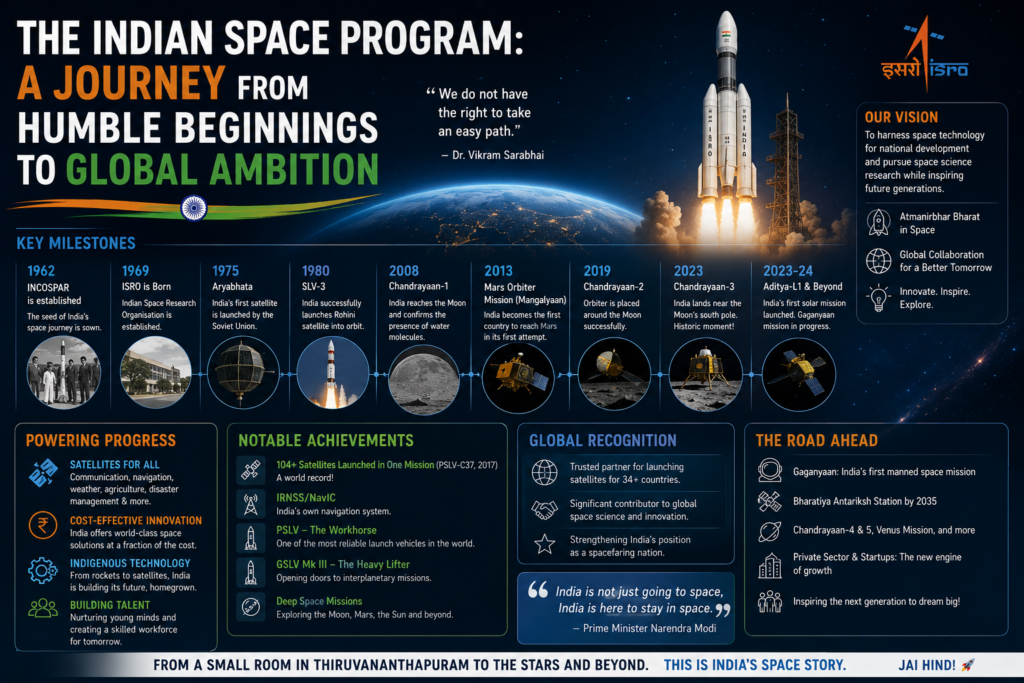
India’s tryst with space exploration is a fascinating story of audacious dreams, relentless hard work, and remarkable achievements. It’s a tale that stretches back decades, transforming a nation once grappling with poverty and technological limitations into a spacefaring power recognized globally. This article delves into the core of the Indian Space Program, exploring its origins, key milestones, present-day accomplishments, and future aspirations. It’s a journey through the cosmos, but also a journey of self-reliance, innovation, and the unwavering spirit of a nation.
The Genesis: Setting the Stage for Cosmic Exploration
The story begins in the 1960s, a time when India was still finding its feet as an independent nation. The seeds of the Indian space program were sown by visionary leaders like Dr. Vikram Sarabhai, often hailed as the father of the Indian space program.
His foresight in recognizing the potential of space technology for national development laid the foundation. Imagine the landscape back then: a nation struggling with issues like food security, poverty, and infrastructure. Yet, Sarabhai understood that space technology could be a game-changer.
The Indian Space Research Organisation (ISRO) was established in 1969, marking the formal beginning of India’s space journey. Initial years were marked by modest ambitions. The focus was on mastering the basics: rocket technology, satellite design, and data processing. These were the building blocks.
The initial funding was minimal, the infrastructure was basic, and the challenges were immense. But the vision was clear: to leverage space technology for the benefit of the common citizen, especially in areas like agriculture, communication, and disaster management.
Early Milestones: Overcoming the Odds
The 1970s and 1980s were crucial periods, marked by significant milestones that demonstrated India’s growing capabilities. Several key achievements stand out:
- Aryabhata (1975): This was India’s first satellite, named after the renowned ancient Indian astronomer. Launched with the help of the Soviet Union, Aryabhata was a symbol of India’s entry into the space age. It was a moment of national pride, proving that India could, against all odds, develop sophisticated technology.
- SLV-3 (1980): The Satellite Launch Vehicle (SLV-3) was India’s first indigenous launch vehicle. While the initial attempts were not entirely successful, the eventual successful launch of the Rohini satellite in 1980 was a major breakthrough. It showcased India’s ability to design, build, and launch its own satellites.
- INSAT Series: The Indian National Satellite System (INSAT) series, starting in the 1980s, revolutionized communication, broadcasting, and meteorology in India. These satellites enabled television and radio broadcasts to reach remote areas, improved weather forecasting, and provided crucial data for disaster management.
These early achievements were not just technological feats. They were also acts of defiance. They demonstrated India’s determination to overcome limitations and build indigenous capabilities. Each success spurred further innovation and fueled the ambition to reach for the stars.
The Modern Era: Charting a Course to the Future
The Indian space program entered a new phase in the 1990s and 2000s, characterized by greater sophistication, expanded capabilities, and ambitious goals. Several key developments shaped this era:
- PSLV: The Polar Satellite Launch Vehicle (PSLV) emerged as a workhorse, providing reliable and cost-effective launches. The PSLV has launched a multitude of satellites for India and for various international customers, making India a significant player in the global space market. Its success is a testament to the engineering prowess of Indian scientists and engineers.
- GSLV: The Geosynchronous Satellite Launch Vehicle (GSLV) was developed to launch heavier satellites into higher orbits. Though initially reliant on foreign technology, the GSLV program gradually developed indigenous capabilities, including the crucial cryogenic engine. This enabled India to launch its own communication satellites and significantly reduce dependence on foreign launch services.
- Chandrayaan-1 (2008): India’s first lunar probe, Chandrayaan-1, achieved remarkable success. It confirmed the presence of water molecules on the Moon’s surface, a significant discovery that boosted India’s scientific credibility and paved the way for future lunar missions. This mission was a landmark in India’s space exploration history.
- Mars Orbiter Mission (Mangalyaan) (2014): India’s Mars Orbiter Mission (MOM) made headlines worldwide. Not only did it successfully reach Mars orbit on its first attempt, but it also did so at a remarkably low cost. This achievement showcased India’s cost-effectiveness and engineering capabilities, and made it the first Asian nation to reach Martian orbit.
These achievements have solidified India’s position as a major space power. They reflect a strategic vision: leveraging space technology for national development, scientific advancement, and international collaboration. The focus is no longer just on launching satellites; it’s on pushing the boundaries of space exploration.
Present-Day Achievements and Programs
The Indian space program in 2026 is a dynamic and multifaceted enterprise, constantly pushing the boundaries of space exploration and technology. Recent years have seen several noteworthy developments:
- Chandrayaan-3 (2023): The successful soft landing of Chandrayaan-3 on the Moon’s south pole was a monumental achievement. India became the first country to land a spacecraft in this challenging terrain, opening new avenues for scientific research and exploration. The mission demonstrated advanced engineering and precision, solidifying India’s status as a leader in space exploration.
- Aditya-L1 Mission (2023): This mission, India’s first dedicated solar observatory, is designed to study the Sun’s corona, chromosphere, and photosphere. The data collected by Aditya-L1 promises to provide valuable insights into solar activity, space weather, and their impact on Earth.
- Gaganyaan Mission: ISRO is working on India’s first human spaceflight mission, Gaganyaan, which aims to send Indian astronauts into space. This ambitious project involves developing advanced technologies, including a crew module, service module, and a launch vehicle capable of carrying humans. The Gaganyaan mission will mark a significant leap for India, demonstrating its capability in human spaceflight and opening doors for future manned missions.
- Continued PSLV and GSLV Launches: These workhorse rockets continue to launch a variety of satellites for various purposes, including Earth observation, communication, and navigation.
- Collaboration and International Partnerships: ISRO is actively collaborating with space agencies around the world, including NASA, the European Space Agency (ESA), and others. These partnerships involve sharing technologies, data, and expertise, fostering innovation and expanding the scope of space exploration.
These present-day achievements and ongoing programs highlight the depth and breadth of India’s space endeavors. They underscore a commitment to pushing technological boundaries, advancing scientific knowledge, and contributing to the global community.
The Economic and Social Impact: Beyond the Cosmos
The Indian space program’s impact extends far beyond the realm of space exploration. It has had significant economic and social implications for the nation:
- Economic Growth: The space sector has spurred economic growth by creating jobs, fostering innovation, and attracting investment. The development of indigenous technologies, such as launch vehicles and satellites, has boosted the manufacturing sector and created opportunities for entrepreneurship. The commercialization of space technologies, including satellite launches and data services, has generated revenue and contributed to the national economy.
- Technological Advancements: The space program has driven technological advancements across various sectors. The development of advanced materials, electronics, and software has had spin-off benefits in areas like telecommunications, healthcare, and infrastructure. These technological advancements have improved the quality of life for citizens and enhanced the nation’s competitiveness.
- Social Benefits: Space technology has played a crucial role in improving the lives of people in India. Satellites provide essential services, such as:
- Communication: Enabling television and radio broadcasts, especially in remote areas.
- Education: Providing educational programs to students across the country.
- Healthcare: Supporting telemedicine and healthcare services in rural areas.
- Disaster Management: Providing early warning systems for natural disasters.
- Agriculture: Providing data for crop monitoring and agricultural planning.
- National Security: Space technology enhances national security by providing surveillance capabilities, early warning systems, and secure communication channels. Satellites play a critical role in monitoring borders, tracking potential threats, and ensuring the safety of the nation.
The space program has become an integral part of India’s progress, contributing to economic growth, technological advancements, and social benefits, ultimately helping the nation move forward on its path to development.
Future Outlook: Into the Next Frontier
The Indian space program is poised for even greater achievements in the years to come. The future outlook includes:
- Expanding Human Spaceflight: Following the Gaganyaan mission, India aims to develop a sustainable human spaceflight program, including establishing a space station and sending astronauts to the Moon and beyond. This ambitious vision will require significant investments in technology, infrastructure, and training.
- Deep Space Exploration: ISRO plans to explore other planets and celestial bodies. This includes missions to Mars, Venus, and asteroids, which will help expand our understanding of the solar system and search for the origins of life. The development of advanced propulsion systems and robotic technologies will be crucial for these missions.
- Commercialization and Space Economy: The Indian government is actively promoting the commercialization of the space sector. This includes encouraging private sector participation in space activities, fostering innovation, and creating a vibrant space economy. The goal is to make India a leading player in the global space market.
- Space Debris Management: With increasing space activity comes the issue of space debris. ISRO is developing technologies and strategies for managing and mitigating space debris, ensuring the sustainability of space operations.
- International Collaboration: ISRO will continue to collaborate with other space agencies on joint missions and initiatives, fostering global cooperation and sharing resources.
The future of the Indian space program is bright. With sustained investment, innovation, and international collaboration, India is poised to become a leading force in space exploration and technology. The ambition is high, but the potential is even higher.
Addressing Common Misconceptions
Like any complex field, the Indian space program is often subject to misconceptions. It’s important to clarify a few common ones:
- “India is spending too much on space while its people are still poor.” This is a common criticism, but it overlooks the significant benefits of space technology. The space program’s focus on areas like agriculture, disaster management, and communication directly improves the lives of millions. Additionally, technological advancements in the space program often have spin-off benefits that can improve many aspects of life.
- “The program is just about prestige.” While national pride is certainly a factor, the Indian space program has a strong focus on practical applications. The development of indigenous technologies and the use of space for national development are key priorities.
- “ISRO operates in isolation.” ISRO actively collaborates with international partners, sharing knowledge and resources, demonstrating its commitment to being a part of the global space community.
These misconceptions often overlook the broader impact of the Indian space program, focusing on narrow perspectives rather than the overall benefits it brings to the nation.
The Unsung Heroes: The People Behind the Success
Behind the glittering successes of the Indian space program are countless unsung heroes: the scientists, engineers, technicians, and support staff who have dedicated their lives to making these achievements possible. They work tirelessly, often facing challenging conditions and limited resources. Their dedication, ingenuity, and passion are the driving force behind India’s space endeavors. They are the true architects of this remarkable story.
FAQ Section
Here are some frequently asked questions about the Indian space program:
- How does ISRO contribute to the Indian economy? ISRO stimulates economic growth by creating jobs, fostering innovation, attracting investment, and commercializing space technologies like satellite launches and data services.
- What are some of the key applications of space technology in India? Space technology is used for communication, education, healthcare, disaster management, agriculture, and national security.
- What is the significance of the Chandrayaan missions? The Chandrayaan missions have enhanced India’s scientific credibility, discovered water molecules on the Moon, and demonstrated advanced engineering capabilities.
- What are ISRO’s future plans? ISRO plans to expand human spaceflight with the Gaganyaan mission, explore other planets like Mars and Venus, commercialize the space sector, and manage space debris.
- How has the Indian space program changed over time? It has evolved from focusing on basic rocket and satellite technology to developing advanced launch vehicles, undertaking complex missions, and achieving global recognition.
- How does India compare to other spacefaring nations? India has become a significant player in the global space market, known for its cost-effectiveness, engineering expertise, and ability to execute complex missions.
- What are the challenges faced by the Indian space program? Challenges include securing funding, managing space debris, and competing with established space agencies.
The Indian Space Program stands as a testament to the nation’s scientific and technological capabilities, inspiring future generations and contributing significantly to the country’s progress. Its legacy is one of resilience, innovation, and an unyielding commitment to reach for the stars. It is a story still being written, with each new mission, each technological advancement, and each international collaboration further solidifying India’s place in the global space arena.
Explore more: Quantum Computing: The Next Technological Revolution and Its Practical Implications and find out more about Infosprout.
– ISRO Official Website: https://www.isro.gov.in/
– ISRO About India’s Space Program: https://www.isro.gov.in/about-isro
– The Indian Express – Space Stories: https://indianexpress.com/
– The Hindu – Science & Technology: https://www.thehindu.com/sci-tech/
– Wikipedia – Indian Space Program: https://en.wikipedia.org/
– NASA – Indian Space Missions: https://www.nasa.gov/
– Economic Times – Space News: https://economictimes.indiatimes.com/